Manufacturers have spent the last decade installing sensors, deploying dashboards, and collecting massive volumes of shop-floor data. But data alone doesn’t drive value. The real competitive edge comes from using that data to make immediate, confident decisions — automatically and intelligently.
In 2026, the difference between average and high-performing factories is no longer just connectivity; it’s decision velocity. The faster a plant can turn machine data into action, the better it performs across quality, efficiency, and throughput.
The Rise of Real-Time Industrial Feedback Loops
Today’s smart factories operate like biological systems. Sensors act as nerves, controllers as reflexes, and AI as a brain. Instead of waiting for shift reports or operator reviews, these systems:
- Detect anomalies within seconds
- Predict deviations before they occur
- Adjust processes dynamically to maintain output goals
This shift from “monitor and report” to “sense and respond” is transforming everything from packaging lines to CNC milling centers. The key: closed-loop systems that learn as they go.
Wiring Decisions at the Edge
To enable real-time decisions, data needs to be processed closer to the source — at the edge. This minimizes latency, reduces dependency on cloud bandwidth, and improves resilience. But edge computing also places higher demands on electrical stability, signal integrity, and harness reliability.
Manufacturers are responding by upgrading how machines are wired — moving from generic cabling to purpose-built wire harnesses that support signal clarity, durability, and flexible layout.
Specialists like Wire Harness Production are enabling this transition by designing industry-specific harnesses that support mixed-signal environments (power + data), ensure clean EMI shielding, and withstand shop-floor abuse like vibration, heat, and chemical exposure. This foundational infrastructure plays a critical, but often invisible, role in ensuring that machine data reaches the right systems, on time, every time.
From Raw Data to Operational Context
Raw data doesn’t mean much until it’s processed and contextualized. In modern factories, that means:
- Tagging signals with production batch, shift, and operator data
- Normalizing units and timestamp formats across machines
- Mapping sensor data to workflow stages
Once contextualized, this data becomes far more useful for training AI, adjusting schedules, or detecting line inefficiencies. For instance, an uptick in torque might look insignificant on its own, but it becomes meaningful when tied to a specific material batch or operator changeover.
Visualizing Decisions to Improve Trust
While real-time AI can trigger autonomous actions, many manufacturers still want human validation for critical decisions, especially in high-mix or safety-critical environments.
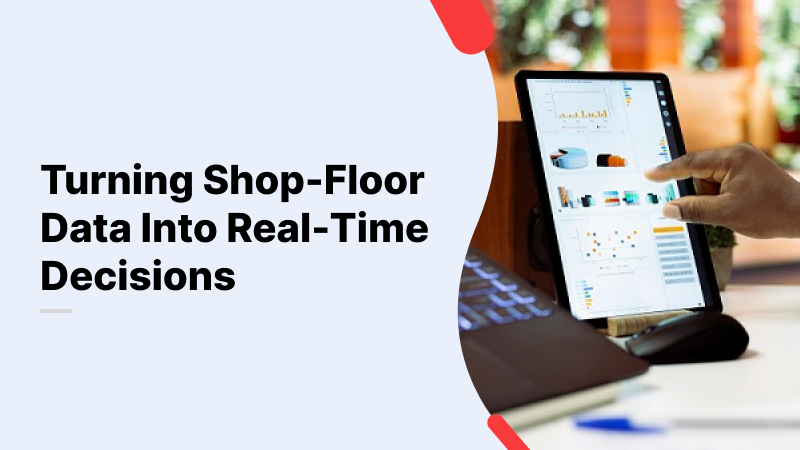
Here, visual dashboards and interfaces still matter. But the role has evolved: instead of simply reporting on KPIs, these dashboards:
- Recommend next-best actions
- Visualize cause-and-effect chains
- Simulate alternative responses
They act as decision aids, not decision makers. Some factories even use custom visual overlays — transforming raw sensor data into annotated images, sticker-style markers for alerts, and modular decision cards.
Creative teams use visual prototyping platforms (originally built for marketing) in production environments to mock up new interface elements. Tools like PhotoToSticker, while not built for industrial use, have inspired production managers to simplify complex alerts into more intuitive visuals, reducing operator confusion and speeding up resolution time.
AI + Decision Velocity = Workflow Autonomy
The most advanced manufacturers in 2026 are not just reacting quickly; they’re letting workflows steer themselves. This is where real-time data meets autonomy.
Examples include:
- A packaging machine rerouting boxes based on downstream congestion
- A quality control station triggering automatic retesting if AI flags uncertainty
- A robotic arm switching gripper patterns based on product size, without operator input
Each of these decisions depends on milliseconds of precision and confidence scores generated by AI models. But the real breakthrough lies in trusting those models to act, not just observe.
Embedding Prompts Into Control Logic
Traditionally, industrial logic followed IF/THEN conditions. But AI-powered systems now use natural-language-style prompts to handle more complex decisions. These prompts act like scenarios:
“If part misalignment exceeds 1.5mm on 3 or more units within 5 minutes, re-center calibration axis, pause new intake, and notify technician.”
The rise of prompt-based control models has made factory automation more flexible — and easier to update without reprogramming.
Inspiration for this approach has even come from generative AI communities. Prompt management platforms like Gemini3Prompt, originally built for creatives, are being repurposed by industrial engineers to organize and version control operational prompts. This helps ensure that AI-powered machines follow predictable, transparent logic, while still allowing adaptation over time.
Scaling Real-Time Decisions Across the Plant
Making one machine smarter is great. But the real power lies in coordination across the floor. This requires:
- A shared time base (synchronized clocks across machines)
- Standardized data tags and semantic models
- A common platform for inter-machine messaging (e.g., MQTT, OPC UA)
Factories are now building plant-wide nervous systems, where alerts in one area trigger cascading adjustments elsewhere — with minimal human intervention.
For example:
- A slowdown in welding triggers a temporary hold in finishing
- Inventory buffers auto-adjust based on real-time consumption
- Energy loads are redistributed in response to equipment cycling
This level of agility requires trust not just in individual AI models, but in the infrastructure that connects and governs them.
Conclusion
In 2026, smart manufacturing isn’t about collecting more data. It’s about using data in the moment to make better decisions and letting machines do more of that work themselves.
The leap from dashboards to decisions doesn’t happen with software alone. It requires upgrading wiring, improving signal quality, integrating visual systems, and deploying adaptive logic that reflects how humans think, but reacts much faster.
The factories that lead won’t be the ones with the most data. They’ll be the ones who turn data into decisions, before anyone has to ask.