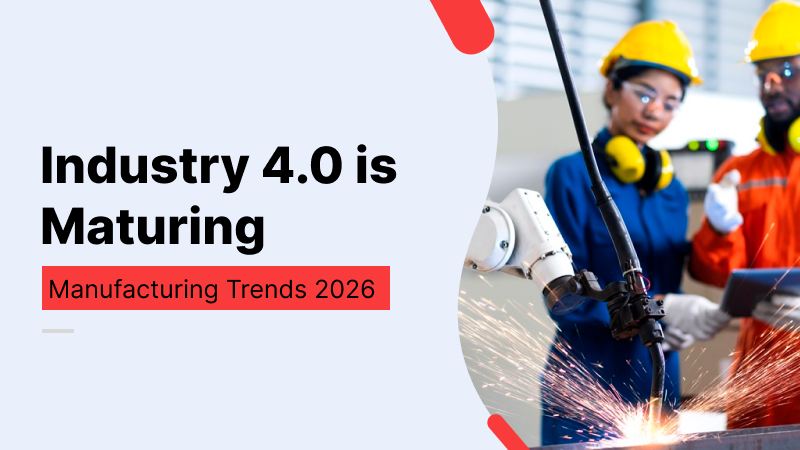
When the term “Industry 4.0” first emerged over a decade ago, it promised a sweeping transformation of how products are designed, built, and delivered. But for years, many manufacturers were stuck in pilot purgatory — testing but rarely scaling technologies like IoT, AI, or digital twins. In 2026, the story has changed. Industry 4.0 is no longer just hype. It’s maturing into a practical, bottom-line-focused set of capabilities that are being implemented at scale.
Today, factories are getting smarter not just in theory but in execution. Let’s explore what’s actually being adopted — and how it’s reshaping production.
AI-Driven Predictive Maintenance Is Becoming Standard
Predictive maintenance was one of the earliest promised use cases of Industry 4.0. In 2026, it’s now a default expectation for competitive manufacturing. Sensors attached to motors, pumps, and conveyors monitor vibration, temperature, and power consumption in real-time. AI models detect anomalies before breakdowns occur.
Manufacturers report significant ROI here: downtime reduction, longer machine lifespans, and fewer emergency repairs. But what’s changed in 2026 is the sophistication. These systems are now self-improving — using machine learning to get better at identifying subtle failure patterns across different equipment types.
Many factories are even integrating wire sizing calculators into their electrical design process to ensure sensor networks are optimised and safe from voltage drops — particularly when retrofitting older facilities.
Digital Twins Go Beyond Simulation
Digital twins — virtual models of physical processes — were once used mainly for product design. Now they are operational tools used daily on the shop floor.
Factories use digital twins to:
- Simulate new production runs before actual implementation
- Predict bottlenecks and optimise workflows
- Monitor live operations using real-time data streams
The shift in 2026 is that digital twins are now connected to live systems. They don’t just simulate — they sync. This allows for adaptive planning and operational testing without halting production. Digital twins are even being tied into training modules using interactive visual guides and flashcard-style learning, often supported by platforms like online flashcard maker tools for rapid onboarding of technicians.
Edge Computing Is Replacing Centralised Control
Data used to be sent to the cloud for analysis. That’s changing. In 2026, manufacturers are implementing edge computing — local processing of data on or near the machines themselves.
This shift is crucial for real-time decision-making where milliseconds matter. For example, in quality inspection systems powered by computer vision, latency can mean the difference between catching a defective product and letting it pass.
Edge devices now manage tasks like:
- Real-time defect detection
- Safety system response
- Local AI inference without external dependencies
Edge computing also improves cybersecurity by limiting exposure to external networks. And it supports sustainability by reducing bandwidth usage — a quiet but important operational cost factor in smart factories.
Interconnected Equipment Through Smart Cabling and Infrastructure
Smart sensors and systems are only as reliable as the electrical and data infrastructure connecting them. As factories become more digitally dense, ensuring proper wire sizing and conduit planning becomes critical to prevent overheating, voltage drop, and inefficiencies.
Manufacturers are now integrating tools like conduit fill calculators into their infrastructure planning to ensure safe, scalable layouts. This is especially important in brownfield factories — older facilities being upgraded with modern systems.
Retrofitting such facilities involves challenges: tight spaces, legacy wiring, and unclear documentation. Smart calculators and layout simulators reduce risks and help electricians and engineers design systems that meet both code and performance standards.
Human-Machine Collaboration, Not Replacement
In 2026, the conversation has moved past “robots replacing workers.” What’s happening on the ground is collaborative automation. Known as “cobots” (collaborative robots), these machines are designed to work with humans, not replace them.
Examples include:
- Robotic arms assisting with heavy lifting or repetitive motion
- AI-guided exoskeletons supporting ergonomic posture for assembly workers
- Voice-assisted interfaces that let workers call up instructions or log quality checks without screens
Training frontline teams to work with these systems is now part of core workforce development, often enhanced through digital tools like flashcards, augmented reality, and gamified learning systems.
Sustainability Metrics Embedded into Production
Green manufacturing is no longer optional. In 2026, sustainability is baked into manufacturing KPIs. Factories are deploying sensors to monitor:
- Energy consumption per unit
- Carbon emissions by process stage
- Material waste and recycling rates
Digital dashboards visualise these metrics in real-time, allowing operators to make trade-off decisions on the fly. For instance, if energy prices spike, the system may suggest rescheduling high-power tasks or switching to backup systems with better efficiency.
Moreover, AI is helping optimise not just output, but impact. Smart systems suggest design changes or material substitutions to reduce carbon footprint while maintaining durability and cost targets.
Cybersecurity as a Manufacturing Priority
With more digital systems comes greater risk. In 2026, cybersecurity is front and centre in smart manufacturing strategies.
Factories are implementing:
- Zero-trust network architectures
- Behavioural anomaly detection
- Endpoint detection and response (EDR) systems on machines
What’s especially new is the integration of OT (Operational Technology) security into everyday production oversight. In the past, IT and OT were managed separately. Now, security is a shared responsibility across departments.
Manufacturers are also running regular digital drills — simulations of cyberattacks that test how teams respond, isolate affected zones, and recover operations.
Modular and Scalable Implementation Is the New Norm
Perhaps the most important development in 2026 is how these technologies are being implemented. Gone are the days of massive, multi-year transformations with unclear ROI.
Instead, manufacturers are taking a modular, agile approach:
- Start with one pilot line or product family
- Measure results (e.g., downtime reduction, defect rates, energy savings)
- Scale successful initiatives incrementally
This strategy reduces risk, improves change management, and allows teams to build internal expertise before scaling. Vendors are also shifting to plug-and-play solutions that work with existing systems, reducing the need for full rip-and-replace overhauls.
Final Thoughts: Industry 4.0 Has Grown Up
In 2026, Industry 4.0 is no longer a wish list — it’s a working reality. Manufacturers are not chasing every shiny innovation. Instead, they’re focusing on scalable technologies that improve productivity, reduce waste, and empower workers.
The future of smart manufacturing isn’t about replacing humans with machines. It’s about creating intelligent systems where machines, data, and people work together — faster, safer, and smarter.
As the landscape continues to evolve, the manufacturers that thrive will be those who implement with intention — guided not by hype, but by measurable results and a clear understanding of what actually works.