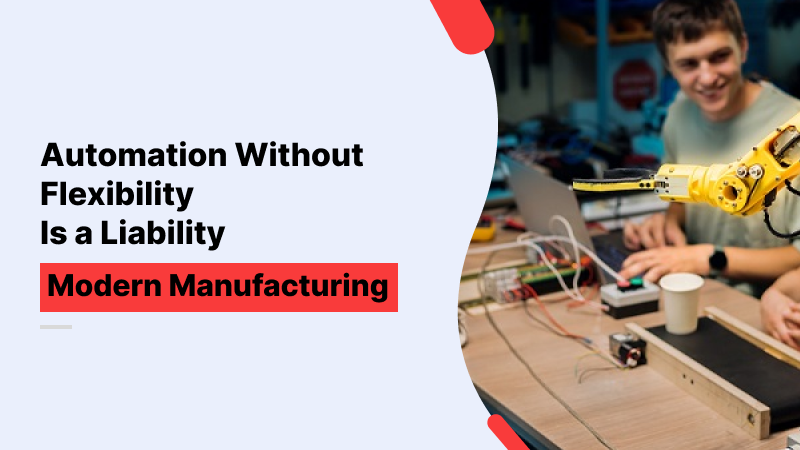
For years, manufacturers believed automation was the ultimate goal. More machines, faster processes, fewer people, all in the name of efficiency. But in 2026, that belief is being challenged. Automation that can’t adapt is no longer a strength; it’s a liability.
In today’s volatile supply chains, shifting customer preferences, and workforce challenges, manufacturers need agile automation — systems that can flex, learn, and pivot. Without that flexibility, even the most sophisticated automation becomes a bottleneck rather than a solution.
Why Rigid Systems Fail in a Dynamic World
Traditional automation thrives in stable, high-volume environments. But when product variants, schedule changes, or raw material disruptions enter the equation, these rigid systems struggle. Common issues include:
- Long changeover times
- High reprogramming costs
- Manual overrides due to unexpected inputs
- Equipment idle time between product runs
Instead of supporting throughput, these systems introduce fragility — requiring excessive effort to adapt to small changes in workflow.
Modular Automation: Building in Flexibility by Design
Leading manufacturers are moving toward modular automation — systems designed to scale up, down, or sideways as needed. These include:
- Robotic cells that can be easily swapped or repurposed
- Equipment with plug-and-play tooling
- Software-defined logic that updates without rewiring
- Mobile autonomous units that flow to wherever bottlenecks occur
This design philosophy enables quicker response to demand shifts, product personalization, and line balancing. It also aligns with lean principles, minimizing waste without sacrificing adaptability.
The gaming industry, interestingly, has long understood the value of modularity. Game developers like BonkMaster have mastered modular asset systems that allow quick updates and content swaps. Manufacturing is borrowing that mindset, building platforms that evolve rather than systems frozen at installation.
Visual Flexibility: Designing for the Unexpected
It’s not just machines that need to be adaptable — workflows and interfaces must evolve, too. Modern manufacturing teams use flexible visual assets for operator instructions, line balancing, and exception handling.
One emerging tactic is using AI-generated backgrounds and dynamic visual cues to help workers understand new configurations. For example:
- Automatically updated workstation diagrams for custom builds
- Visual alerts that shift color or shape depending on task status
- Modular interface overlays for mixed-skill workers
Creatives in the industrial sector have started using tools like ShotBG, originally built for background removal in marketing, to build real-time, instruction-layer overlays that reduce operator confusion during rapid reconfiguration.
This visual agility complements physical agility, allowing teams to adjust on the fly without slowing down.
Electrical Planning That Doesn’t Lock You In
Rigid automation often stems from rigid infrastructure. Poorly planned wiring, fixed control cabinets, and overloaded junction boxes can make reconfiguring lines expensive or even impossible without downtime.
To support flexibility, engineers are now prioritizing:
- Scalable conduit systems
- Wireless I/O for sensors and controls
- Distributed power and data nodes
- Detachable harnesses with labeled connectors
They’re also using predictive tools like the PCB Cost Calculator to budget and plan for scalable circuit design — accounting for future feature integration, space constraints, and durability under varied loads.
Flexible electrical infrastructure ensures that adding, removing, or modifying equipment doesn’t require tearing down the system or risking safety compliance.
The Human Factor: Training for Change
No automation system is truly flexible unless the people operating it are prepared for change. That means:
- Cross-training workers on multiple systems
- Involving frontline teams in reconfiguration planning
- Using digital twins and simulations for quick adaptation
- Rewarding initiative and flexibility on the floor
In factories with a flexible culture, people are not afraid of changes to the line — they’re empowered to lead them. And as equipment becomes more adaptive, it’s the human mindset that determines whether that potential is realized.
AI-Driven Flexibility: From Reactive to Anticipatory
The next frontier of flexible automation is AI-enabled foresight. Smart systems can now:
- Detect early signs of deviation and recommend proactive changes
- Forecast product demand shifts and auto-schedule lines accordingly
- Optimize line configurations based on part availability or workforce
- Suggest preventive maintenance before failures occur
This anticipatory behavior turns automation into a living system — one that adjusts not just to current conditions, but to what’s coming next.
AI doesn’t just make automation faster — it makes it smarter and more fluid, unlocking a new level of operational agility.
Final Thoughts: Rethinking the Automation Mindset
In 2026, automation isn’t just about doing more with less — it’s about doing more with what you already have, under any conditions. The manufacturers that are thriving today aren’t necessarily those with the most advanced equipment or the biggest budgets. They’re the ones who have designed their systems, processes, and cultures to remain resilient, adaptable, and responsive in the face of constant change.
This resilience is layered across every dimension of the factory. Mechanically, it means embracing modular tools and mobile robotics that can be redeployed quickly as product lines shift or customer demand fluctuates. Instead of relying on fixed, single-purpose machines, these factories use automation components that can be recombined and repurposed with minimal downtime.
On the electrical front, flexible infrastructure is key. Smart wiring layouts, distributed power nodes, and scalable control boards ensure that adding a new machine or reconfiguring a line doesn’t require weeks of rewiring. These elements make it possible to adjust automation setups quickly and safely — a major competitive advantage when speed is everything.