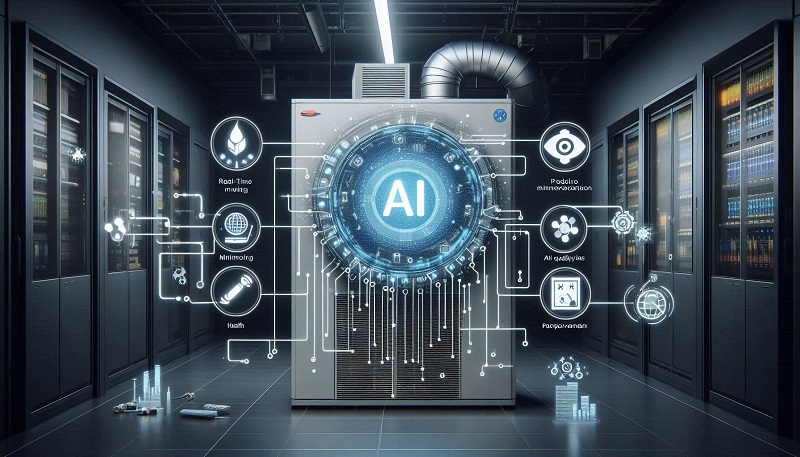
Commercial HVAC systems don’t usually fail in obvious, dramatic ways, they decline quietly over time. As buildings become more complex and performance expectations rise, traditional monitoring methods struggle to catch problems early enough to prevent costly downtime. This is where HVAC AI and AI in HVAC are starting to change how failures are understood, detected, and prevented long before equipment actually breaks.
Why HVAC AI Struggles With Failure Prediction
Because HVAC systems don’t usually “fail” in a single, obvious moment, they drift into failure.
Most breakdowns are the result of small inefficiencies stacking up over time: slightly imbalanced airflow, gradual refrigerant loss, minor sensor inaccuracies, or components compensating for each other until something finally gives. Systems often operate in a technically acceptable but progressively inefficient state for long periods, with performance degradation staying within manufacturer tolerances until a physical limit is reached. Masks develop around underlying issues, and by the time a technician sees a problem, the damage is already happening. This is especially common in variable-load equipment like a heat pump, where control logic, sensor accuracy, and load matching can gradually drift while the system continues operating within acceptable limits.
The real challenge has always been that HVAC failures are pattern-based, not event-based, and humans simply can’t monitor thousands of subtle performance changes across every operating condition in real time. Traditional maintenance and monitoring tools rely on fixed schedules, manual inspections, and alarms designed to detect threshold violations rather than long-term behavioral drift, which made early failure prediction largely impractical, even before AI for HVAC systems became viable.
What AI in HVAC Actually Means
In commercial HVAC, AI HVAC isn’t a robot controlling your building, it’s a continuous decision-making layer sitting on top of your existing equipment.
AI for HVAC analyzes real-time and historical performance data to understand how a system should behave under specific conditions, then flags when behavior starts to deviate, even slightly. Rather than replacing existing building automation systems, AI in HVAC industry applications learn what “normal” looks like for that specific building, not a generic spec sheet, and monitor system behavior against historical performance and expected outcomes.
For commercial systems, AI HVAC system platforms turn HVAC from a reactive asset into a self-monitoring system that constantly evaluates efficiency, operational risk, and performance trends across the entire facility, allowing inefficiencies and abnormal patterns to surface before they become visible failures.
How AI for HVAC Systems Predicts Failure Early
AI predicts failure by identifying behavioral changes long before mechanical limits are reached.
Instead of waiting for a compressor to overheat or a motor to trip, AI for HVAC systems tracks micro-signals: longer runtimes, slower response times, abnormal cycling patterns, rising energy draw under the same load, or subtle temperature drift across zones. These small changes often appear weeks, or months, before a breakdown and indicate stress, imbalance, or compensation. In systems like a heat pump, these signals often show up as longer runtimes, reduced capacity during mild weather, or increased cycling as the system compensates for small performance losses.
The key difference is that HVAC AI doesn’t look for one “bad” number. It looks for patterns that don’t match historical performance, even if everything still appears within normal operating ranges, flagging persistent deviations as early indicators of failure risk.
The Data Powering AI HVAC System Predictions
An AI HVAC system pulls from far more than basic temperature readings. Depending on the system, AI HVAC may analyze run times and cycling frequency, energy consumption patterns, supply and return temperature deltas, airflow and pressure changes, valve, damper, and actuator behavior, vibration and motor load data, weather conditions and occupancy trends, and historical maintenance records.
The power of AI for HVAC comes from connecting these data points, not reviewing them in isolation. A slightly higher energy draw might mean nothing, unless it coincides with longer runtimes, reduced airflow, and a specific outdoor temperature range. By correlating operational, environmental, and historical data across time and conditions, AI in HVAC can identify risk patterns that individual metrics cannot reveal and see issues humans often miss.
How AI HVAC troubleshooting Works in Practice
Traditional diagnostics answer the question: “What’s broken right now?”
AI HVAC troubleshooting answers: “Why is this system trending toward failure?”
Traditional diagnostics focus on identifying which component has failed after a problem becomes visible. AI HVAC troubleshooting identifies how and why system performance is degrading before failure occurs.
Instead of testing components one by one, AI in HVAC industry solutions trace cause-and-effect relationships across the system, showing how control logic, mechanical wear, and operating conditions interact to create long-term stress. They identify the root cause path, revealing how one issue creates downstream stress elsewhere in the system, such as a control sequence issue forcing equipment to compensate unnecessarily and leading to premature wear on compressors or fans.
This shifts troubleshooting from guesswork and reactive testing to data-backed decisions that fix the real problem, not just the symptom, leading to corrective actions that address root causes rather than repeated symptom-level fixes.
Where AI for HVAC design Fits Long Term
AI for HVAC design changes HVAC planning from static calculations to living system models.
During planning, AI for HVAC design can simulate how different equipment configurations will perform under real-world conditions, seasonal load swings, occupancy changes, future expansion, and energy price fluctuations. Over time, AI in HVAC supports HVAC design and planning by validating real-world performance against original design assumptions, using long-term operational data to refine equipment sizing, control strategies, retrofit decisions, and replacement timelines based on actual system behavior rather than theoretical lifespan estimates.
In short, AI for HVAC design turns HVAC design into a long-term performance strategy, not just a one-time engineering exercise.
The Business Impact of AI HVAC
AI HVAC reduces downtime by intervening earlier, when fixes are smaller, cheaper, and easier to schedule. Instead of emergency repairs, teams can plan maintenance around early warnings, replacing a failing component before it damages surrounding equipment. This shifts maintenance from reactive to targeted and predictive, lowering labor costs, preventing cascading failures, and reducing unnecessary strain on equipment.
Over time, buildings using AI for HVAC systems see fewer unplanned outages, more predictable service schedules, lower total maintenance spend, longer equipment replacement cycles, and significantly extended asset life. The biggest savings often come from avoided failures, not faster repairs.
Limits of AI in HVAC industry Adoption
AI in HVAC industry adoption is only as effective as the data and system integration behind it.
Older buildings may lack sensors, consistent controls, or clean historical data, and poor installation, incorrect sequences of operation, or outdated BAS setups can limit AI HVAC system accuracy. While AI excels at pattern recognition, it cannot correct installation errors or mechanical defects on its own and still relies on skilled professionals to interpret insights and execute solutions correctly.
AI for HVAC doesn’t replace HVAC expertise, it amplifies it, and its value grows as system quality improves.
How AI HVAC Is Changing Commercial Teams
AI in HVAC shifts teams from constant firefighting to strategic system stewardship.
Technicians spend less time chasing alarms and more time preventing issues, while engineers focus on optimization instead of reactive fixes. Facility managers gain visibility into long-term performance trends, allowing teams to prioritize work based on risk and efficiency rather than urgency. Rather than replacing jobs, AI HVAC elevates them, turning HVAC teams into performance managers, not just repair crews.