From year 2026 to 2035, the specialty chemicals industry will have consistent and reliable growth by focusing on performance, customization and sustainability instead of commodity pricing. The purpose of this analysis is to provide information on market size drivers, segment and regional dynamics, competitor trends, and risks. Companies will need to adopt strategic actions in order to continue capturing value for the next ten years.
Market size and growth outlook
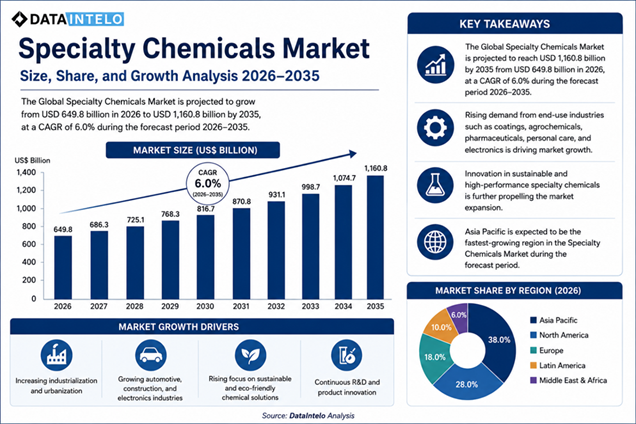
Estimates of the size of the worldwide specialty chemicals sector in the thousands of billions of dollars in the mid-2020s, with estimates for mid-single-digit compound annual growth until approximately 2035 and reach roughly a dozen trillion dollars or so in the early-to-mid 2030s. The inconsistency among various published numbers comes primarily from slight differences in definition (what types of products and applications are included) as well as assumptions about incomes. The consistent trend is robust growth over a long period of time, primarily due to higher-value uses/demand, leading to reformulation driven by sustainable performance.
According to Data Intelo, the global specialty chemicals sector is on a steady upward trajectory. Valued at roughly $620 billion in 2023, the market is anticipated to climb to approximately $970 billion by 2032. This expansion represents a steady Compound Annual Growth Rate (CAGR) of 5.2% over the next nine years.
Drivers of growth
- Customer Industries Are Experiencing Increased Demand from Manufacturers to Create End-Use Performance Materials That Have Exact Properties Instead of Just Having Large Quantities of Material; therefore, Many Different Sectors (Electronics, Automotive [Especially EVs], Construction, Personal Care, & Health Care) Will All Continue To Have Strong Demand for Adhesives, Coatings, Specialty Polymers and Functional Additives as End-Use Manufacturers Continue to Look to Purchase Performance-Based Products.
- Environmental Regulations Are Driving Global and Regional Manufacturers to Formulate New Lower VOC Content Products As Part of Corporate Sustainability Initiatives To Achieve Net Zero Emissions or Circular Economy Coatings
- Customers Are Now Demanding Unique Product Formulations, Technical Support, and Lifecycle Services from Specialty Producers; This Will Enable Many Specialty Manufacturing Companies To Charge Premium Pricing Because Of The Level Of Customization Required By End-Users.
- Advancements In Catalysis, Polymer Chemistry & Improved Process Intensification Are Creating Many New Functional Material Types (e.g., Lightweight Polymers for EV Batteries, Battery Electrolyte Materials, Advanced Chemicals/Additives, etc.) And therefore Causing Development of High-Growth Niche Markets.
- Geopolitical Risk and Supply Chain Disruptions Have Resulted in Many Manufacturers Moving Their Production Facilities to Locations ClosertTo Their Key Markets Which Will Generate significant New Investment In The Near Future.
Regional landscape
- The Asia-Pacific Region is still the strongest & fastest growing market in the world now because of its good manufacturing capabilities, electronics and automobile production increasing, and increased consumer demand. The R&D investments & establishment of local manufacturing hubs will continue.
- The North American market is focused on High Value Specialty Chemicals (Advanced Polymers, Performance Coatings, and Chemicals Related to Life Science) due to their strong Research & Development base and their stringent Environmental Regulations providing a strong demand for Premium Products.
- The European Markets have to comply with regulated environmental requirements which drives the production and adoption of Sustainable Products and primarily affects any company’s ability to sell units based upon their level of compliance and Level of Sustainability.
- The Latin American & African regional markets have historically faced Slow Adoption rates, but there are still mainly growth and opportunities that exist in these regions as the Agricultural Chemicals market, Construction Chemicals, and as each of their respective local industrial sectors grows as a result of reducing Import dependency.
Segment outlook (what to watch)
- Coatings & Additives – Continued growth opportunities from automotive refinishes, architectural coatings, and industrial protective coatings, along with a significant shift to low or non-VOC and durable or long-life chemistries.
- Adhesives & Sealants – Increasing demands from EVs, electronics assembly, and construction, particularly for performance adhesives to aid in light weighting.
- Specialty Polymers & Intermediates – Medical devices; flexible electronics; lightweight automotive components; all contributing to an innovation cycle and premium pricing.
- Agrochemicals & Crop Protection Formulations – Improvements in formulation and new delivery methods will continue to drive growth within agricultural areas that need higher yields.
- Electronic Materials and Battery Chemistries – Rapid growth driven by semiconductors, displays, 5G infrastructure and energy storage for both EV battery applications and grid storage solutions.
Competitive dynamics
The chemical industry consists mainly of large integrated chemical companies and smaller, more nimble specialty chemical companies. The competitive advantage has evolved from the ability to leverage size and scale to a combination of an organization’s technical capability, sustainability credentials, and service orientation. As organizations continue to pursue faster access to niche technologies, seek regional presence and green chemistry platforms through mergers, acquisitions, and partnerships will continue to be a common and prevailing trend.
Risks and constraints
- The volatility of feedstock inputs and cost fluctuations will affect profit margins and the ability of companies to compete in petroleum based on feedstocks and critical minerals.
- New laws and regulations regarding environmental & health safety have provided additional costs for companies producing these products or requiring a new formula to be developed with regards to historical products.
- Changing plants to accommodate for low-emission or recyclable materials or bio-based production processes is capital intensive in nature and requires a significant amount of time to accomplish these upgrades.
- Geopolitical and trade risk have created new regional restructuring costs due to export controls, tariffs, and supply chain disruptions.
Opportunities and strategic moves
- Place an emphasis on sustainable innovation with investments in renewable resource-based inputs and recyclable chemistry or processes of manufacture that meet customer and regulatory expectations.
- Provide a more comprehensive approach to formulation by integrating formulation support, testing services, application development/training as well as lifecycle services to build long-term customer relationships and associated higher margins.
- Focus your R&D and commercialization efforts specifically in high growth market sectors such as battery materials, lightweight polymers for electric vehicles (EVs), advanced electronic materials, specialty agrochemicals, etc.
- Develop/deploy local manufacturing capabilities within Asia/Pacific (and other high-growth regions) to reduce your lead time to market, minimize exposure to tariffs, and comply with local content requirements.
- Flexible Business Models by providing toll manufacture, contract develop and co-development partnerships to customers who desire accelerated delivery and customized product solutions without significant capital investment.
Action checklist for executives
- Conduct a sustainability audit on product portfolios and reformulate as necessary
- Redirect R&D towards low toxicity and circular chemistry
- Enhance application labs and technical service offerings for customers
- Diversify feedstock sources and establish strategic supplier contracts
- Identify acquisition and/or partnership opportunities to acquire battery/electronic/bio-based capability
- Develop additional regional manufacturing or distribution facilities in Asia/Pacific and Latin America.
Short example use-case
A supplier of specialized resins transitions from using solvent-based coatings to water-based coatings in Europe and North America, where they also create water-based compliant specialty resin products for use in Europe and North America. The company uses their specialized coating application knowledge to offer retrofitting alternatives in developing countries to generate additional revenue based on their compliance investment and improve their profit margins.